Exaud Blog
Blog
Code Audit vs Code Review: Key Differences Explained
Code audits and code reviews serve different purposes. Learn when each one applies, and which your team needs right now.Posted onby ExaudIf you've ever used "code audit" and "code review" interchangeably in a meeting, you're in good company. Most developers have, at some point. The terms sound related, and they are, but they describe fundamentally different activities with different purposes, different scopes, and different triggers.
Getting this distinction right matters more than it might seem. Asking for a code review when you need a code audit is a bit like asking for a spell check when what you need is a structural edit. One is a routine quality step; the other is a forensic examination. Both are valuable. Neither substitutes for the other.
The Short Answer
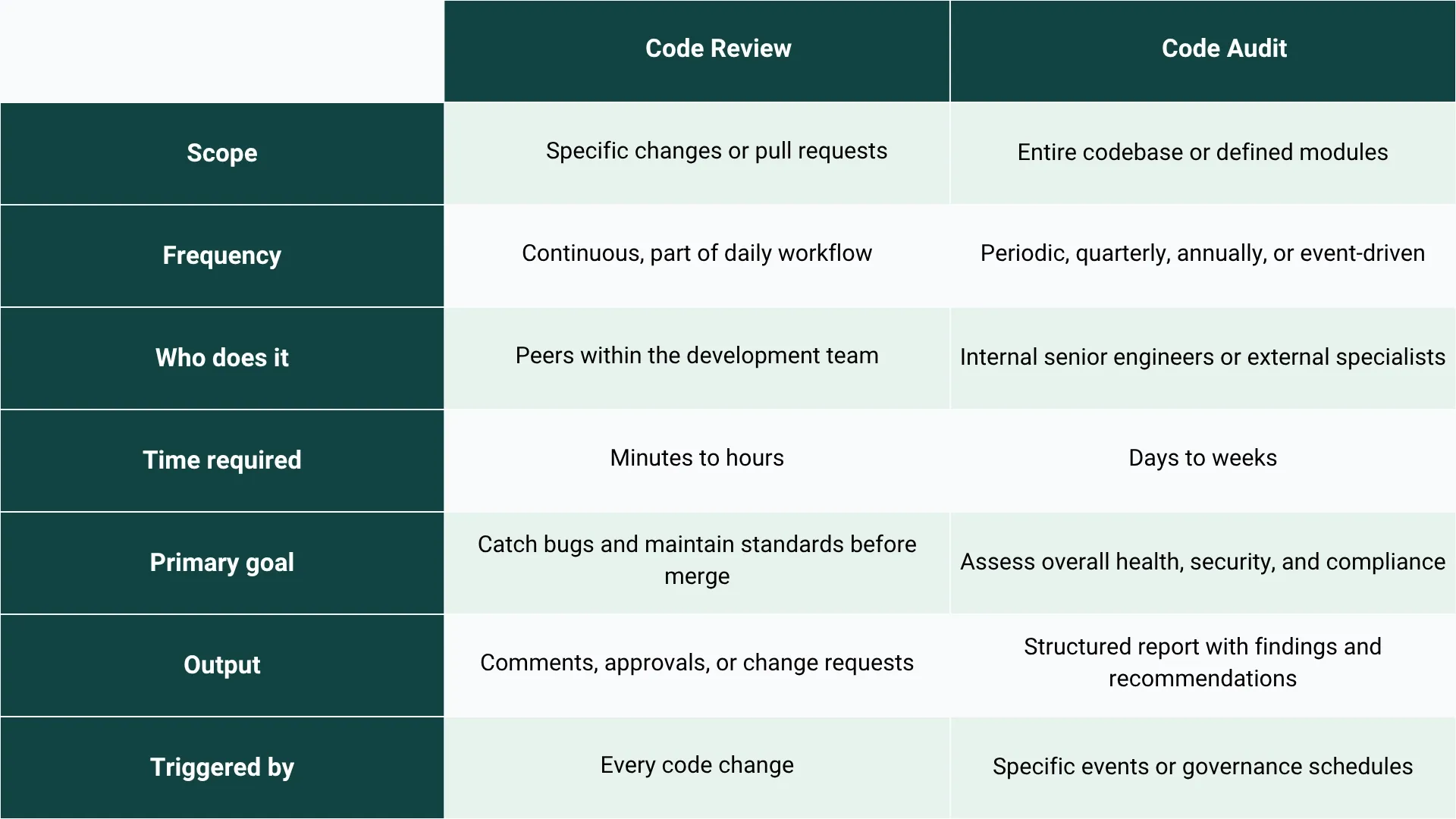
A code review is a routine, incremental quality check embedded in the development workflow. It happens continuously, focuses on specific changes, and is typically done by peers within the team. A code audit is a comprehensive, structured evaluation of a codebase, or a significant part of it, carried out with specific objectives: security, compliance, technical debt assessment, or architectural readiness. It's periodic, broader in scope, and often involves external expertise. The table below captures the core distinctions at a glance:
What Is a Code Review?
A code review is the process by which one or more developers examine code written by a colleague before it's merged into the main codebase. It's a fundamental practice in modern software development, part of what makes continuous integration work at a human level. The goals of a code review are specific and bounded:
-Catch bugs early, before they reach production, where they cost significantly more to fix
-Maintain code standards, ensuring the new code follows the team's conventions for naming, structure, and style
-Share knowledge, code reviews are one of the most effective mechanisms for spreading context about how a system works across a team
-Prevent technical debt accumulation, catching shortcuts and questionable patterns before they become embedded in the codebase
Code reviews are deliberately limited in scope. A reviewer is looking at a diff, the specific changes introduced by a pull request, not the entire system. That's by design. The goal is to keep the feedback loop tight and the velocity high. What code reviews are not designed to do is assess the cumulative state of a system, identify architectural risks that span multiple components, or evaluate security posture across the full codebase. That's not a failure of the practice, it's simply outside its remit. Good code review practices, such as keeping pull requests small, writing descriptive commit messages, and giving constructive rather than prescriptive feedback, make a material difference to team productivity and code quality over time. If your team is looking to strengthen this practice, our guide to effective QA and review comments covers the mechanics in detail.
What Is a Code Audit?
A code audit is a structured, comprehensive evaluation of a software system's source code. Where a code review looks at what's changing, a code audit looks at what's there, and what that means for the security, maintainability, and longevity of the product. A thorough code audit combines automated analysis with expert-led manual review, and typically covers:
-Security vulnerabilities across the entire codebase, including issues that automated tools miss
-Architectural soundness, whether the system's design supports its current requirements and where it will struggle as it scales
-Technical debt, accumulated complexity, duplication, and shortcuts that are slowing development down
-Dependency health, outdated, vulnerable, or poorly maintained third-party packages
-Compliance, alignment with GDPR, HIPAA, PCI DSS, or other applicable frameworks
-Test coverage quality, not just the percentage, but whether the right things are being tested
A code audit produces a structured report with prioritized findings and actionable recommendations, not inline comments on a pull request. The output is designed to inform strategic decisions: what to fix immediately, what to schedule, and what the overall risk profile of the system looks like.
Where They Overlap, and Where They Don't
The confusion between the two practices is understandable because they share some surface-level characteristics. Both involve engineers reading source code. Both are aimed at improving software quality. Both can surface bugs. But the overlap ends there. Here's where they diverge meaningfully:
Scope and depth
A code review is focused by definition, it examines a bounded set of changes. A code audit is intentionally broad. It's looking for patterns, systemic issues, and risks that only become visible when you step back from the individual change and look at the whole.
Timing and trigger
Code reviews happen continuously as part of the development process. Code audits are event-driven or schedule-driven: before a major release, after a significant staff change, before an investment round, or on a regular governance cadence.
Who's involved
Code reviews are typically done by team members who are already familiar with the codebase. Code audits, particularly for security or compliance purposes, are most effective when they involve people who aren't. External auditors bring objectivity and a calibrated sense of what "normal" and "risky" look like across many different codebases.
Output and audience
A code review produces comments in a PR and a merge decision. A code audit produces a document that may be read by engineering leads, CTOs, board members, investors, or regulators. These are different audiences with different needs, and the output is structured accordingly.
A Common Misconception: "We Do Code Reviews, So We Don't Need Audits"
This is probably the most costly confusion in practice. Code reviews are excellent at preventing new problems from entering the codebase. What they're structurally unable to do is identify problems that are already there, problems that accumulated over months or years, that became normalised, or that only become apparent when the system is viewed as a whole. Consider a few scenarios where code reviews alone are insufficient:
Architectural drift
A system that was designed for one scale is being asked to operate at another. Individual PRs look fine. The problem isn't in any specific change, it's in the accumulated mismatch between the architecture and the current requirements. A code review process will never surface this; a code audit will.
Security posture
A team following good code review practices can still have a codebase with meaningful security vulnerabilities. Some vulnerability classes, logic flaws, privilege escalation paths, insecure data flows across components, are simply not visible at the PR level. They require a system-level view.
Inherited code
If you're taking ownership of a codebase you didn't build, code reviews tell you nothing about the existing state of the system. An audit does.
Compliance requirements
If your product operates in a regulated domain, a code review process is not a compliance audit. Regulators are not asking whether you review PRs, they're asking whether the system meets specific technical and process controls.
When to Use Each, A Practical Guide
Use code reviews for:
-Every code change, without exception
-Maintaining standards and conventions as the team grows
-Knowledge sharing and mentorship within the team
-Preventing the introduction of new bugs and technical debt
Trigger a code audit when:
-You're approaching a major release or product launch
-You're inheriting a codebase you didn't build
-Development velocity is declining without an obvious cause
-You're preparing for a funding round or acquisition
-Your product operates in a regulated industry and you need compliance assurance
-It's been more than 12 months since the last audit
-You've had a security incident and need to understand the full exposure
They're Complementary, Not Competing
The most resilient engineering organisations don't choose between code reviews and code audits, they run both, with clear understanding of what each is for. Code reviews keep the development process healthy on a day-to-day basis. They prevent quality from degrading incrementally. Done well, they also serve as a knowledge-sharing mechanism that keeps the team's understanding of the codebase current. Code audits provide the periodic, independent, system-level view that code reviews structurally can't. They catch what accumulates between reviews, assess what was there before the review process existed, and give engineering leadership the information they need to make good decisions about technical investment. Think of it this way: code reviews are the daily habits that keep a system healthy. Code audits are the periodic health checks that tell you how the system is actually doing, and what to watch out for.
At Exaud, we help software teams strengthen both practices, from supporting better code review culture within development teams, to running rigorous external code audits that give leadership a clear picture of system health. If you'd like to talk through what your codebase needs, get in touch.
Related Posts
Subscribe for Authentic Insights & Updates
We're not here to fill your inbox with generic tech news. Our newsletter delivers genuine insights from our team, along with the latest company updates.