World’s first programmer was a woman: Ada Lovelace’s legacy
The presence of women in scientific and technological fields is one of the most important steps towards the progress of science and society. The story of Ada Lovelace is just a sign that the world, too, is written in the feminine. Discover the woman and the ideas that shaped today’s digital age!Posted onby Beatriz Martins
Who’s Ada Lovelace?
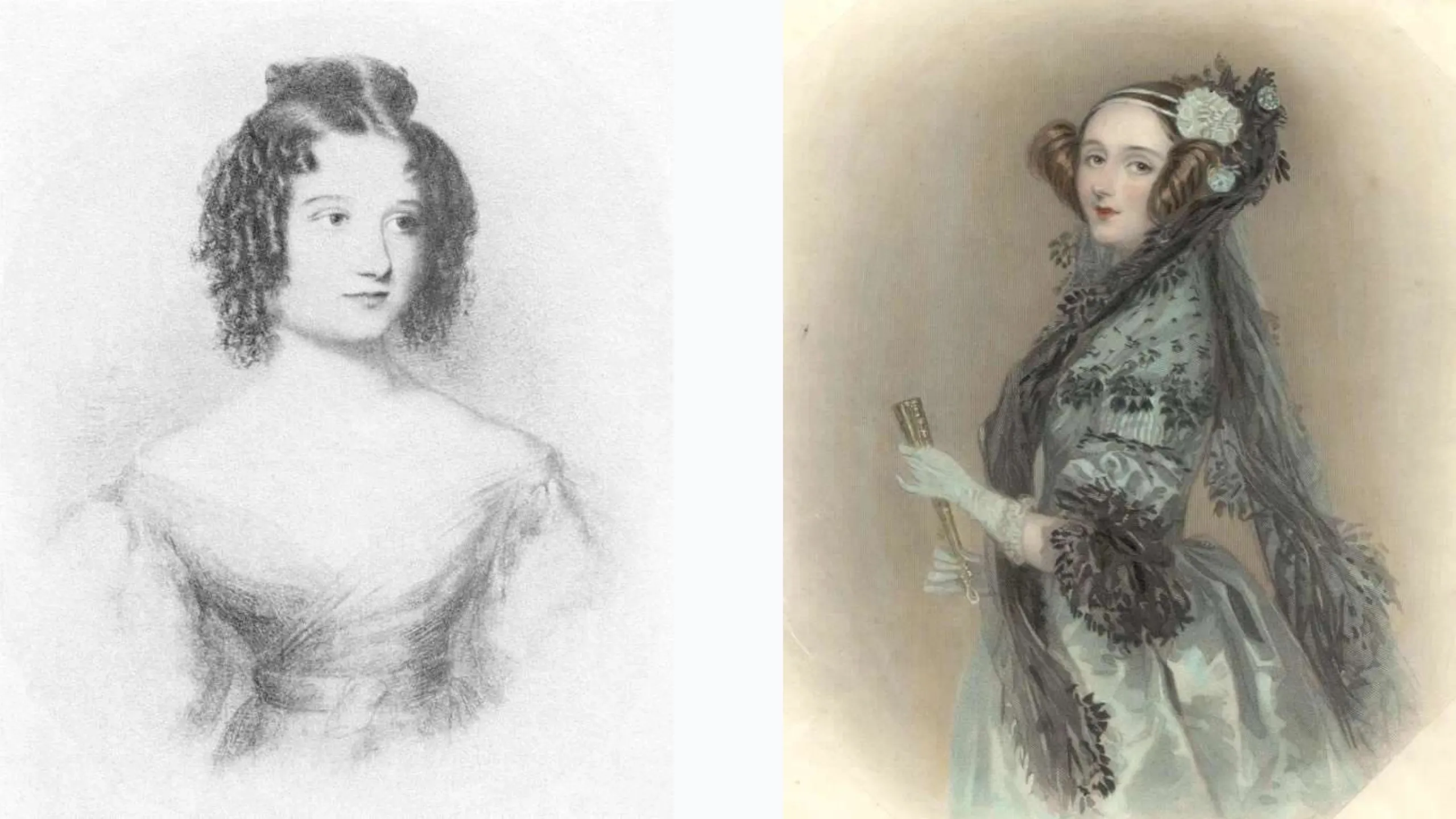
Born in London in 1815, Lovelace was the daughter of George Gordon Byron, known as Lord Byron, one of the emblematic figures of the British Romantic poetry movement, and Anne Isabella Milbanke, a mathematics enthusiast.
Determined that her daughter should develop a sharp analytical mind rather than a poetic sensibility of her father, Ada, under her mother's influence, ended up receiving an education focused on mathematics and science, which was quite rare for a woman in the 19th century.
Her curiosity, both encouraged and innate, led her to take an interest in the inventions of Charles Babbage, often referred to as the “father of the computer,” and by the Analytical Engine he was designing. The Analytical Engine was a machine intended to perform complex calculations, functioning in some ways like an early programmable calculator. It was through her work with this machine that Ada Lovelace’s legacy as one of the pioneers of programming truly began.
Ada Lovelace was the visionary who imagined the future of computing, but how did it all begin?
In her thirties, Lovelace translated a short scientific paper about Babbage’s Analytical Engine., According to sources, she took on this task because she “knew the machine so well” (Padua, n.d.). Although the device was never built, its design and components already represented an extraordinary blueprint for what we now recognize as modern computers.
What makes this translation particularly remarkable is that Lovelace added her own notes, which later proved essential to the scientific and technological development and understanding of Charles Babbage's invention. In fact, the comments she added were even longer than the original article! In her observations, there were several mentions of “computer programs” and the potential uses for the device, including the manipulation of symbols and even suggested that such a machine might one day be capable of producing music!
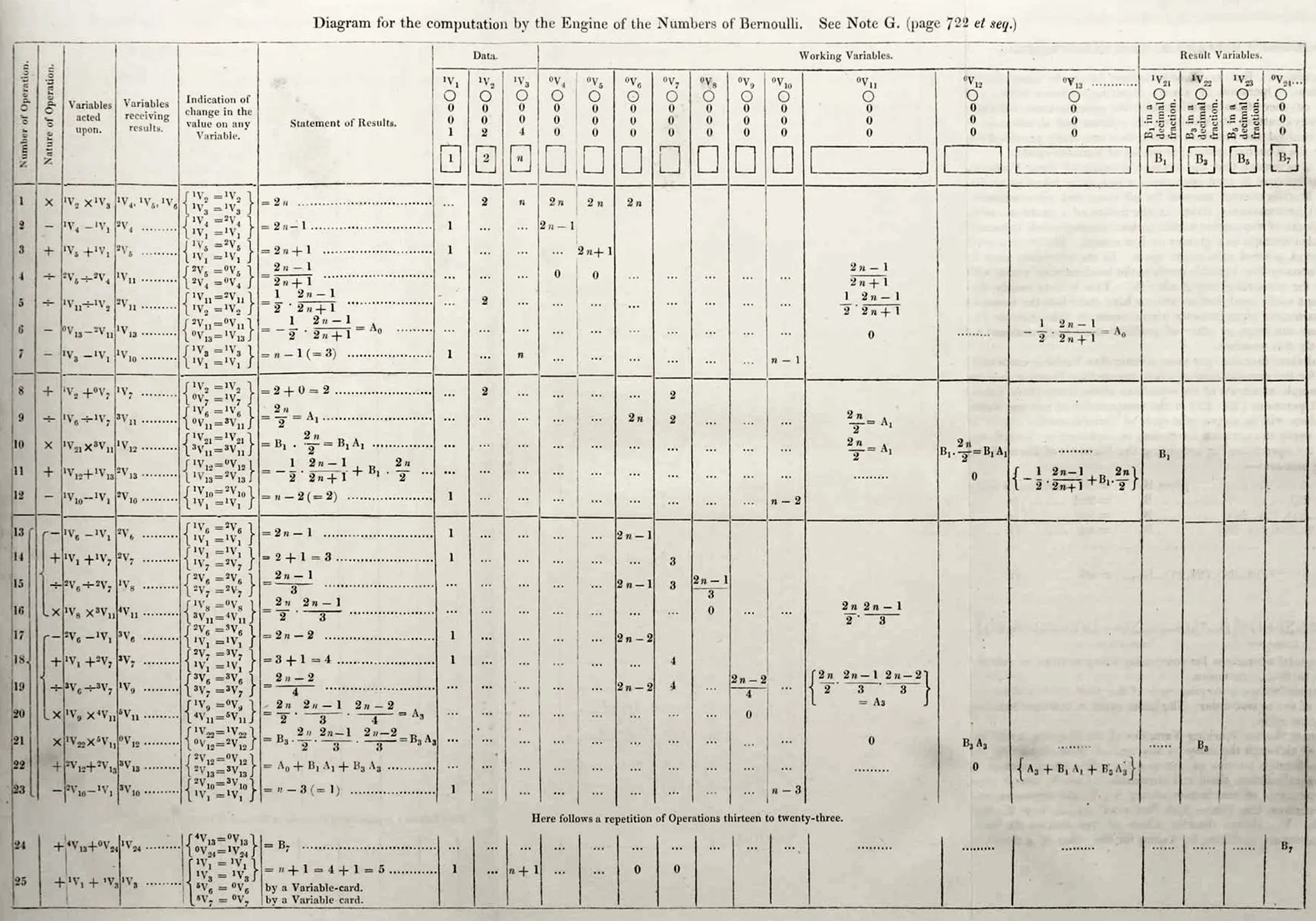
It would be inconceivable to think that Babbage and his assistants had not already thought of some of these possibilities, however Ada Lovelace managed to deliver detailed and comprehensive notes on a step-by-step method for calculations - being considered the first published computer algorithm - using the Analytical Engine. For this reason, she is often considered the world’s first computer programmer.
Her work demonstrates that, more than a century before electronic computers were built, Ada Lovelace had already envisioned the idea of general-purpose computing.
Lovelace's diagram from "Note G", the first published computer algorithm. Source: Wikimedia Commons
What about her legacy?
Ada Lovelace's legacy is there for all to see, but how did her ideas translate into the scientific and technological world?
As mentioned earlier, although the Analytical Engine was never completed and built during her lifetime, Lovelace's concepts became the fundamental basis for Computer Science studies.
Today her legacy lives on in multiple ways, such as:
- The programming language Ada programming language was named in her honor;
- Her work is studied in the field of Computer Science;
- She became a global symbol for women in technology.
Why female representation matters in Science and Tech?
The representation of women in STEM (Science, Technology, Engineering, and Mathematics) fields is currently a widely debated topic, as it has been proven that the inclusion of women in traditionally male-dominated fields fosters innovation, equality, and the future workforce.
Greater participation means not only more people contributing to scientific progress, but also more role models for young individuals who are interested in pursuing careers in science. Seeing themselves represented helps them realize that these paths are open to them as well.
Diversity has repeatedly proven to be a powerful driver of progress. Different perspectives encourage creativity, strengthen problem-solving approaches, and foster innovation: all essential elements for both technological and societal development.
On International Women’s Day, Ada Lovelace’s legacy reminds us of the importance of continuing to expand opportunities for education and careers in scientific fields. By writing the first published algorithm, Lovelace did more than make history, she also helped lay the foundations of the digital age that continues to shape our world today.
We're not here to fill your inbox with generic tech news. Our newsletter delivers genuine insights from our team, along with the latest company updates.