AI in Predictive Maintenance for Manufacturing | Exaud
Most predictive maintenance stops at the alert. See how AI agents connect sensor data to planned repairs in manufacturing, and what it takes to get there.
Posted onby Exaud
AI fever Vs Predictive Maintenance value.
Most manufacturers that have tried predictive maintenance have reached the same point. Sensors are installed, data flows into a dashboard and a model raises an alert when a motor or a pump starts to behave differently. Then the alert sits there. Someone has to work out what it means, check the machine's history, find a spare part, agree on a stop with production and create a work order. Too often that takes long enough for the failure to happen anyway.
Detecting an anomaly is only useful if it leads to the right action at the right time. In many plants, that link still depends on people reading alerts, often from several systems, and deciding what to do. When alerts are frequent and some turn out to be false, teams start to ignore them.
The result is that maintenance stays largely reactive even where monitoring is in place. In MaintainX's State of Industrial Maintenance survey of more than 1,300 maintenance professionals, 58% said their teams still spend more than half their time reacting to breakdowns.
The full chain, from sensor to action
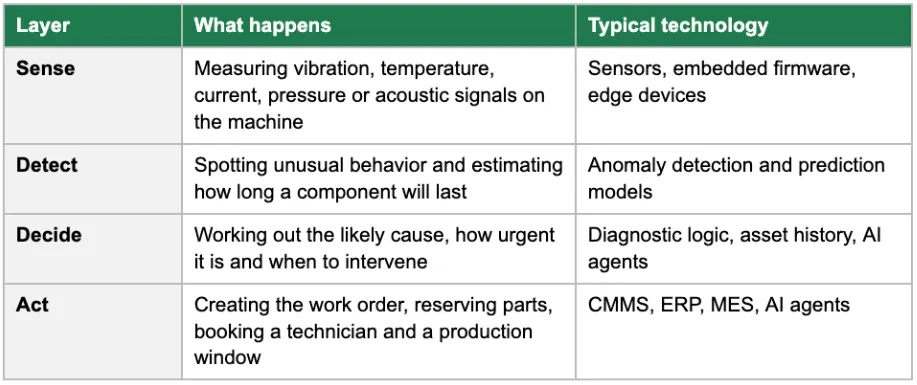
It helps to see predictive maintenance as four connected layers. Most projects cover the first two well and leave the last two to manual work.
It starts at the device
The quality of every decision further along depends on the data collected at the machine. That is an embedded engineering problem as much as a data science one. Choices about sampling rates, which signals to capture, how much processing happens on the device and how data is sent all shape what the models can see.
Processing at the edge is often necessary. A vibration sensor sampling thousands of times per second produces far more data than it makes sense to send to the cloud, so the device itself filters, compresses or analyzes the signal and sends only what matters. This also keeps detection working when the network is slow or down. Power use, hardware cost and long-term maintenance of the devices all need to be considered from the start, which is whyembedded engineering services are usually involved early in these projects.
Security matters here too. Every connected sensor is a possible entry point into the plant network, and the risks are similar to those we described in our article onsecuring critical infrastructure with embedded systems. For the connectivity and platform side, see ourIoT solutions page.
Detection is getting better, but it it not the end goal
Anomaly detection models learn what normal looks like for a machine and flag deviations. Prediction models go further and estimate the remaining useful life of a component. Both work best when they have context: a motor running at full load behaves differently from one at idle, and a model that ignores operating conditions will raise false alerts.
Even a good model only produces a signal. On its own, it does not tell the maintenance team whether to stop the line tonight, wait for the weekend or ignore the alert.
From anomaly detection to maintenance orchestration
This is where AI agents come in. An agent can take an alert and carry out the steps a planner would otherwise do by hand, using the same systems. As we explained in our article onAI agents in operations, the difference from older automation is that agents can reason over several sources and decide what to do next within set limits.
A typical sequence might look like this:
●Diagnosis. Vibration on a pump bearing has been rising for three days. An agent compares the pattern with the asset's history and similar past failures and concludes that the bearing is the likely cause.
●Prioritization. It checks how critical the pump is to production and estimates how much time is left before failure.
●Planning. It checks spare parts stock in the ERP, the production schedule in the MES and technician availability, and finds the best window for the repair.
●Action. It creates the work order in the CMMS, reserves or orders the part and sends the plan to the maintenance supervisor for approval.
●Feedback. After the repair, the technician's findings are recorded and used to improve the next diagnosis.
In practice these steps are often split between several specialized agents that work together, an approach we covered in our article onmulti-agent systems for enterprise workflows.
Interest in this direction is growing. A recent Manufacturing Dive report on agentic AI noted that most experts point to predictive maintenance as the strongest use case for agentic AI in manufacturing. Adoption of AI in general is still uneven, though. Deloitte's Smart Manufacturing and Operations Survey found that 29% of manufacturers use AI or machine learning at facility or network level, while 23% are still piloting it.
What it takes to make it work
Connecting sensors to action is mostly an integration and data problem. The main requirements are:
●Access to the systems that act. Agents need to read from and write to the CMMS, ERP and MES. Older systems without APIs often need some modernization first.
●Reliable asset data. Equipment hierarchies, maintenance history and failure records must be accurate, or the agent will make decisions on poor information.
●Clear rules and approval limits. The business has to decide what an agent can do alone and what needs a person, for example by cost, criticality or production impact.
●Security across IT and OT. Giving software the ability to create work orders or change schedules means access must be controlled and every action logged.
●A feedback loop. What technicians find on site should go back into the models, otherwise accuracy stops improving.
Autonomy should grow in steps
Few plants will hand maintenance decisions to software overnight, and they should not. A practical path has three stages:
●Recommend. The agent analyzes alerts and suggests what to do, and people make every decision.
●Prepare and approve. The agent prepares the work order, parts and schedule, and a supervisor approves with one click.
●Act within limits. For low-risk, well-understood cases, the agent acts on its own and reports what it did.
Moving from one stage to the next should depend on measured results, such as how often the agent's recommendations were accepted and how many failures were avoided.
Where to start
The best first project is usually one type of asset with a known failure mode, existing sensors and a clear cost when it fails, such as critical pumps, compressors or motors. That keeps the scope small enough to measure and gives the team a working loop from sensor to action that can then be extended. OurAI development team can help assess where that loop breaks today.
Frequently asked questions about AI & Predictive Maintenance
What is the difference between predictive and preventive maintenance?
Preventive maintenance follows a fixed schedule, such as replacing a part every six months. Predictive maintenance uses data from the equipment to decide when maintenance is actually needed, which avoids both unnecessary work and unexpected failures.
What role does AI play in predictive maintenance?
AI models detect unusual behavior in sensor data and estimate when a component is likely to fail. AI agents can then take those results and plan the response, from diagnosis to creating the work order.
What is maintenance orchestration?
It is the coordination of everything that has to happen after a problem is detected: diagnosis, prioritization, spare parts, technician scheduling and production planning. AI agents can handle much of this across the CMMS, ERP and MES, with people approving the decisions that matter.
What is edge processing important for predictive maintenance?
Many sensors produce more data than is practical to send to the cloud. Processing on the device reduces data volume, cuts response time and keeps monitoring running if the connection fails.
Do you need new sensors to start with AI predictive maintenance?
Not always. Many machines already have sensors or controllers that produce useful data. The first step is usually to check what data is available and whether it is good enough, then add sensors only where there are gaps.
We're not here to fill your inbox with generic tech news. Our newsletter delivers genuine insights from our team, along with the latest company updates.